Memoirs of a Kamikaze by Kazuo Odachi
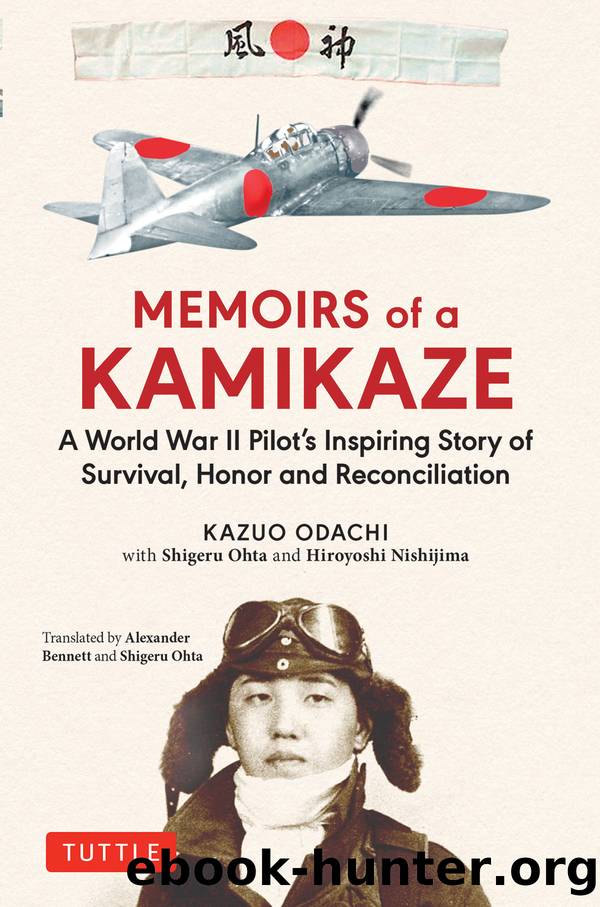
Author:Kazuo Odachi
Language: eng
Format: epub
Publisher: Tuttle Publishing
Kamikaze Casualties
Kamikaze suicide attacks met with some degree of success around the beginning in October 1944. Both the Navy and Army utilized this tactic continually at the front in the Philippines. At the battles in Okinawa, many suicide planes took off from bases in Kyushu and Taiwan to target Allied troopships. Not limited to Zeros, almost all Navy and Army aircraft were used for Kamikaze attacks. In the final stages of hostilities, even canvas covered training planes were commandeered. Most, however, were shot down by intercepting fighters before reaching enemy ships. Those which managed to evade interceptors were often shot down by high-performance anti-aircraft machine-guns on the ships. Nevertheless, it has been estimated that around 11 percent (another source claims 16 percent) of Kamikaze airmen successfully reached their intended targets.
It is true that the Kamikaze caused more damage than conventional attacks. Approximately 3600 Army and Navy aircraft were used in Kamikaze attacks in the ten months from October 1944 to August 1945. There is varying data concerning the number of Kamikaze casualties. One official document recognizes the names of all those who perished in Kamikaze attacks: 2,517 Navy and 1,440 Army personnel, making 3,957 in total.
As for the damage caused by Kamikaze missions, 34 ships were sunk with around 300 sustaining damage. Among those sunk, 3 were escorting carriers, 13 were destroyers, and 18 other types of vessel. The 300 that were damaged included 16 regular carriers, 20 escorting carriers, 15 battleships, 15 cruisers, and 101 destroyers.
The Navy already started developing various weapons for suicide missions before the commencement of Zero Kamikaze attacks. Among them, Ouka was a kind of single-man rocket carried to its target by a Type-1 Ground Attacker. The Ouka was released when approaching the target and hurtled into the enemy ship. The Kaiten was a small oneman submarine with a warhead located at the front. It was transported by a destroyer and fired at the enemy, which is why it was called “Human torpedo.” The Shinyo was a small motorboat loaded with explosives that was driven into enemy shipping. All of these weapons were deployed in battle, and more were in the process of being developed when the war came to an end.
According to American sources, suicide missions did succeed in delaying the U.S. advance in the Philippines and Okinawa. Prominent Japanese novelist Shohei Ohoka (1909 – 88), who himself was drafted into the Army and served in the Philippines, published a famous book titled War Chronicle of Leyte (1974). In it he writes the following:
“Although it was touted that Japanese victory was imminent, by this stage of the war none of the commissioned officers believed it. They were strung along by the illusion that even one more victory would benefit Japan’s position in the peace negotiations. They acted to save face and concealed their true objective with the guise of ‘strategy.’ More abhorrent was sending young men to needless deaths in Kamikaze suicide operations all in the name of ‘eternal Justice.’
Nevertheless, of the more than
Download
This site does not store any files on its server. We only index and link to content provided by other sites. Please contact the content providers to delete copyright contents if any and email us, we'll remove relevant links or contents immediately.
Personalized inhaled bacteriophage therapy for treatment of multidrug-resistant Pseudomonas aeruginosa in cystic fibrosis by unknow(181719)
CONSORT 2025 statement: updated guideline for reporting randomized trials by unknow(90147)
Critical evaluation of the ProfiLER-02 study design and outcomes by Vivek Subbiah & Razelle Kurzrock(89750)
Cardiac gene therapy makes a comeback by Oliver J. Müller & Susanne Hille & Anca Kliesow Remes(89510)
Whisky: Malt Whiskies of Scotland (Collins Little Books) by dominic roskrow(74452)
Unveiling the design rules for tunable emission in graphene quantum dots: A high-throughput TDDFT and machine learning perspective by Şener Özönder & Mustafa Coşkun Özdemir & Caner Ünlü(50905)
A yeast-based oral therapeutic delivers immune checkpoint inhibitors to reduce intestinal tumor burden by unknow(40277)
Covalent hitchhikers guide proteins to the nucleus by Alexander F. Russell & Madeline F. Currie & Champak Chatterjee(40220)
Meet the Authors: Christopher R. Mansfield and Emily R. Derbyshire by Christopher R. Mansfield & Emily R. Derbyshire(40104)
Alkaline-earth metals promote propane dehydrogenation with carbon dioxide through geometric effects: Altering the reaction pathway by unknow(32742)
Induced iron vacancies boosting FeOOH loaded on sustainable Fenton-like collagen fiber membrane for efficient removal of emerging contaminants by unknow(32522)
Efficient electric-field-assisted photochemical conversion of methane to n-propanol exclusively over penetrated TiO2Ti hollow fibers by Guanghui Feng(32460)
Bi2SiO5 nanosheets as piezo-photocatalyst for efficient degradation of 2,4-Dichlorophenol by Hangyu Shi & Yifu Li & Lishan Zhang & Guoguan Liu & Qian Zhang & Xuan Ru & Shan Zhong(32400)
A novel NDIPTA organic heterojunction photocatalyst with built-in electric field for efficient hydrogen production by Jiahui Yang & Baojun Ma & Yongfa Zhu(32372)
Enhanced conversion of methane to liquid-phase oxygenates via hollow ferrite nanotube@horseradish peroxidase based photoenzymatic catalysis by Jun Duan & Shiying Fan & Xinyong Li & Shaomin Liu(32339)
Ordered macroporous superstructure of defective carbon adorned with tiny cobalt sulfide for selective electrocatalytic hydrogenation of cinnamaldehyde by Xiao-Shi Yuan & Sheng-Hua Zhou & San-Mei Wang & Wenbo Wei & Xiaofang Li & Xin-Tao Wu & Qi-Long Zhu(32263)
What's Done in Darkness by Kayla Perrin(27155)
Topological analysis of non-conjugated ethylene oxide cored dendrimers decorated with tetraphenylethylene: Insights from degree-based descriptors using the polynomial approach by A Theertha Nair & D Antony Xavier & Annmaria Baby & S Akhila(26543)
Investigation of mechanical and self-healing properties of hydroxyl-terminated polybutadiene functionalized with 2-ureido-4-pyrimidinone by Mohsen Kazazi & Mehran Hayaty & Ali Mousaviazar(26469)
